The CSA bounty is amazing! Collard greens, new potatoes, summer squash, cucumber, Anaheim peppers, and Dragon Tongue beans. Plenty of variety and a very generous amount for a small share. Looking at this fresh, edible, vivid rainbow in my bag, I couldn't help but feel cheerful and energized (or maybe I was just feeling the effects of the coffee that I downed on a relatively empty stomach. ;) ).
I already ate almost half of the cucumber as a side with my sandwich this afternoon, and plan on making a potato salad with the potatoes. Once I finish up a quinoa salad that's serving as my dinner, I plan on experimenting with the collard greens, squash, and Dragon Tongue beans. I'm thinking I might just toss them all together in a pan and sautee them with garlic, olive oil, and the oregano as a side dish to to go with some poached chicken breasts or try my hand at making some pan-fried chicken under the guidance of this recipe, and thus incorporating the oregano this way rather than in with the veggies. Not quite sure what I'll do with the Anaheim peppers, but I'm sure I can find some recipe to try.
Short and sweet post today. I was just so excited about this first CSA share that I had to... well... share! =)
Sunday, July 15, 2012

Wednesday, July 11, 2012
Putting the Oregano to Work and Other Kitchen Happenings
One of my favorite things to do is challenge myself to use the remaining ingredients used in a planned dish to create an impromptu, unscripted dish. I do this for various reasons: creative exercise, preventing waste, and uncontrollable frugality (which I swear is a genetic trait I inherited from my mother). Sometimes it works, and sometimes it doesn't. Monday night it worked quite deliciously, and I got to use my fresh oregano sooner than I thought I would (waiting on those veggies from the CSA). It was just a simple, summer pasta salad made with leftover, precooked pasta from a bolognese dinner, but it totally hit the spot, a quick, fresh meal to end a long day. Since the pasta was already cooked, all I had to do was chop up a (complimentary) tomato, pluck a handful of oregano leaves off the peduncle, slice them into thin strips, and toss the tomato and oregano in the pasta with olive oil, salt, and pepper. Easy, herb-inspired yums!
I also like substitutes for "traditional" ingredients, and while this isn't herb-related, I'm going to share anyway (because it has potential to be herb-related). This revelation emerged from a culinary situation that was equal parts misfortune and serendipity. Tuna salad is my lunch this week, and as I began to gather the various ingredients (mayo, olive oil) and available accoutrements (onion, celery, salt, pepper), I found that two of the items had gone bad: the celery and the mayo. Celery is an inconsequential ingredient, but something like mayo is pretty important, even though I use it sparingly (that's what the olive oil is for, to add moisture). Son of an orangutan's aunt, I thought to myself. I had just come from the grocery store and really didn't feel like going back out, but I was counting on the tuna for lunch! What to do, what to do? I scanned the fridge, and hidden under containers of hummus and parmasen cheese, I found some idling goat cheese. Voila! Yes! With its creamy consistency and tangy flavor, goat cheese could work as a viable mayo substitute--in concert with the olive oil--and perhaps be even better. I dumped the remainder of the goat cheese in with the tuna and onion, added olive oil, sprinkled in a dash of salt and fresh ground pepper, and mixed up my experiment. Results: total yum! Indeed, I like this version of tuna salad way better than a mayo-based version; it's more flavorful, and the mayo ick-factor is completely eliminated. I'm eager to try it again and experiment with adding some fresh herbs (see, told you I'd tie in herbs some how!). I love how something potentially inconveniencing ended up in a new discovery that improved upon my existing tuna salad paradigm. It's the little things! =)
I also like substitutes for "traditional" ingredients, and while this isn't herb-related, I'm going to share anyway (because it has potential to be herb-related). This revelation emerged from a culinary situation that was equal parts misfortune and serendipity. Tuna salad is my lunch this week, and as I began to gather the various ingredients (mayo, olive oil) and available accoutrements (onion, celery, salt, pepper), I found that two of the items had gone bad: the celery and the mayo. Celery is an inconsequential ingredient, but something like mayo is pretty important, even though I use it sparingly (that's what the olive oil is for, to add moisture). Son of an orangutan's aunt, I thought to myself. I had just come from the grocery store and really didn't feel like going back out, but I was counting on the tuna for lunch! What to do, what to do? I scanned the fridge, and hidden under containers of hummus and parmasen cheese, I found some idling goat cheese. Voila! Yes! With its creamy consistency and tangy flavor, goat cheese could work as a viable mayo substitute--in concert with the olive oil--and perhaps be even better. I dumped the remainder of the goat cheese in with the tuna and onion, added olive oil, sprinkled in a dash of salt and fresh ground pepper, and mixed up my experiment. Results: total yum! Indeed, I like this version of tuna salad way better than a mayo-based version; it's more flavorful, and the mayo ick-factor is completely eliminated. I'm eager to try it again and experiment with adding some fresh herbs (see, told you I'd tie in herbs some how!). I love how something potentially inconveniencing ended up in a new discovery that improved upon my existing tuna salad paradigm. It's the little things! =)
Monday, July 9, 2012
Oh, Oregeno!
The oregeno is here! I set right to re-potting it into something more comfortable and roomy (actual pot courtesy my mama):


Looking good, right? I hope to keep it that way. I was super excited yesterday because I thought it was my first pick-up day for the CSA I joined recently, and I couldn't wait to find a recipe that incorporated the veggies in my share and my newly-acquired oregano. But alas, I got my days mixed up and when I went to the pick-up site, there were no fresh fruits and veggies awaiting me. Total bummer of my own scatterbrained doing! No worries though: something to look forward to for next Sunday.
Tuesday, July 3, 2012
What's Your Inflorescence Type?
I've been doing some more botany-focused reading on herbs, and in doing so, have learned a little bit about the botanical terms for the anatomical structures of a plant. Of particular relevance is the inflorescence, or simply the cluster of flowers on the plant. Inflorescences are categorized according to their arrangement off the main stem (peduncle). The image below illustrates a few of the more common inflorescences.
Even with only a very superficial investigation of inflorescences, it became evident to me that these nine common categories barely scratch the surface of all the different variations of inflorescence arrangements that exist in the natural world. Additionally, some species of plants present with anomalous inflorescence formation, which do not quite fit into the existing categories, and, consequently, are erroneously categorized as one or the other simply for sake of putting them somewhere.
I can't help but see a parallel between this sort of plant classification and classification of human personality (and perhaps even psyche). Perhaps we may fall into general, broad-sweeping categories, but there will always be that about us which remains impervious to the reducible effects of categorizing behavior.
All seriousness aside, let's have some fun with this. I'm sure most of you are familiar with personality typing based on things like color preference, etc., so let's see what your inflorescence preference says about you. Take a good look at the image above and choose an inflorescence that you like best (excluding the compound umbel). Then find the corresponding inflorescence below and discover things about yourself that you never knew. No cheating!
Spike: You are a contrary sort and depending on your mood, this can either work to your benefit and manifest as courage and assertiveness in your dealings with others; or backfire and come across as just plain cantankerousness and therefore repellent to those you encounter.
Raceme: Dynamism defines you. You have a synergistic, lively balance between your creative side and your computational side. There is a strong possibility that you might be perfect.
Panicle: You are eccentric, in taste, style, and mood. To keep up with your varied interests, you always have a lot going on, and it's never the same thing twice. You are prone to abusing substances.
Umbel: Logic and order is the name of your game. You pride yourself on your organizational skills and responsible nature. You readily see patterns in nature, work, and play, and love categorizing any and all material things. This is your favorite post of the entire blog.
Corymb: You are easy-going and level-headed. Nothing seems to ruffle your feathers--er--leaves. You take the ebbs and flows of life in stride, a veritable surfer of the cosmos. Sometimes your carefree disposition leaves you lounging on the beach for too long though.
Cyme: Ambition drives you in most activities. You don't feel satisfied unless you have put in a long, hard-day's work and see results from the work that you've done. Relaxing is not your strong suit. Having a stiff drink from time to time would do you some good.
Cluster: You are plain.
Solitary: Ever so elegant you are. You carry yourself in a sophisticated manner and are privy of all the trends in fashion, music, and food, of which you ravenously indulge. Whether or not you are solitary in your epicurean pursuits is uncertain, but it's quite possible.
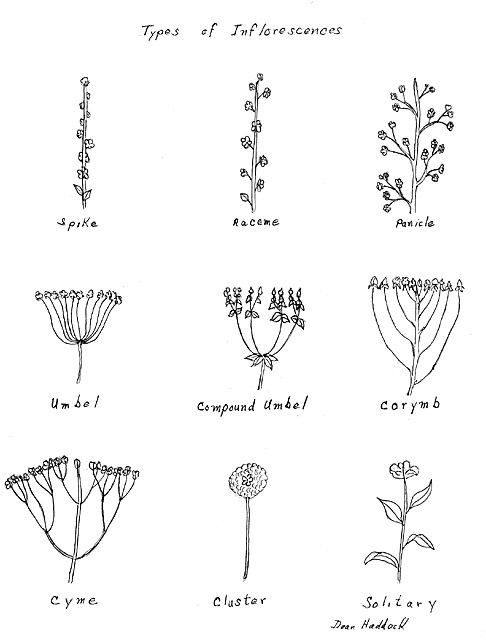 |
| Image reproduced from Kansas Wildflower and Grasses website: http://www.kswildflower.org/drawings.php?drawingID=5 |
I can't help but see a parallel between this sort of plant classification and classification of human personality (and perhaps even psyche). Perhaps we may fall into general, broad-sweeping categories, but there will always be that about us which remains impervious to the reducible effects of categorizing behavior.
All seriousness aside, let's have some fun with this. I'm sure most of you are familiar with personality typing based on things like color preference, etc., so let's see what your inflorescence preference says about you. Take a good look at the image above and choose an inflorescence that you like best (excluding the compound umbel). Then find the corresponding inflorescence below and discover things about yourself that you never knew. No cheating!
Spike: You are a contrary sort and depending on your mood, this can either work to your benefit and manifest as courage and assertiveness in your dealings with others; or backfire and come across as just plain cantankerousness and therefore repellent to those you encounter.
Raceme: Dynamism defines you. You have a synergistic, lively balance between your creative side and your computational side. There is a strong possibility that you might be perfect.
Panicle: You are eccentric, in taste, style, and mood. To keep up with your varied interests, you always have a lot going on, and it's never the same thing twice. You are prone to abusing substances.
Umbel: Logic and order is the name of your game. You pride yourself on your organizational skills and responsible nature. You readily see patterns in nature, work, and play, and love categorizing any and all material things. This is your favorite post of the entire blog.
Corymb: You are easy-going and level-headed. Nothing seems to ruffle your feathers--er--leaves. You take the ebbs and flows of life in stride, a veritable surfer of the cosmos. Sometimes your carefree disposition leaves you lounging on the beach for too long though.
Cyme: Ambition drives you in most activities. You don't feel satisfied unless you have put in a long, hard-day's work and see results from the work that you've done. Relaxing is not your strong suit. Having a stiff drink from time to time would do you some good.
Cluster: You are plain.
Solitary: Ever so elegant you are. You carry yourself in a sophisticated manner and are privy of all the trends in fashion, music, and food, of which you ravenously indulge. Whether or not you are solitary in your epicurean pursuits is uncertain, but it's quite possible.
Tuesday, June 26, 2012
When Herbs Fall Into Your Lap
My chiropractor is pretty awesome. She keeps my chronic neck pain at bay and keeps a welcoming, friendly practice. She also keeps an organic garden, growing a myriad of vegetables to use for cooking and canning. And she also grows herbs. During one of my sessions, in between her effective yet gentle adjustment of my spinal column, I happened to mention my indoor herb-growing project, and we bonded further over our appreciation for fresh, homegrown produce.
At my session last week, we were both inquiring into each other's growing projects. Sadly, I had to retell the demise of my little seedlings, but we both had a good laugh from the story. It just so happened though that she has a surplus of oregano and dill plants, and kindly offered some to me. Still not feeling quite ready to recommence the project, my thoughts tripped over each other trying to make a quick decision to her benevolent gesture. I'm not really sure if they ever arrived at a firm decision, but I found my mouth saying an autonomous, self-assured 'yes' anyway. I left my session with my spine aligned and the promise of new herbs to jump-start my growing project currently in abeyance.
With this impromptu adoption, I have some preparing to do. I've gone back to consult with my herb books on dill and oregano as well as looking up their profiles on this herb website, and nothing seems too terribly beyond a novice skill level. My chiropractor warned me that dill, unmanaged, can grow freakishly tall. And oregano; well, oregano seems like it might be pretty tame. More importantly than reading up on care, I need to purchase the proper substrate for these plants. I hadn't yet bought any soil for more mature herb plants: all I have on reserve is seedling soil. Actually, stike that. I DO have some soil that I bought for repotting a regular houseplant that had been blown off the sill by a very assertive wind. It's organic soil that was on sale for super cheap at Walgreen's and while it's just fine for a plant I don't plan on ingesting, I'll need to read the label more carefully to see if it's okay to use for crop-type plants. I don't see why it wouldn't be, but you never know. And finally, I need to prepare pots for these newcomers. Again, while I had coffee cans on reserve to use for transplanting once the seedlings were mature, I hadn't yet poked drainage holes in them; this shouldn't be too hard though: just need a good hammer and some nails. But believe it or not, I have neither of these lying around my apartment!
As I'm writing this entry, I feel refreshed and excited about these herbs unexpectedly breezing into my life. I'm particularly excited about cooking with fresh oregano, because I have never done so before. (If anyone has any favorite recipes using fresh oregano, please share!). I feel invigorated by the unending fluidity of this project: I like that what I planned isn't what has happened, and I like that I like it. There is something uniquely liberating about allowing life to present you with its offerings without filtering their merits through a thick, cheesecloth web of thought.
The moral of the story: When herbs fall into your lap, let them. And then worry about how they will grow.
At my session last week, we were both inquiring into each other's growing projects. Sadly, I had to retell the demise of my little seedlings, but we both had a good laugh from the story. It just so happened though that she has a surplus of oregano and dill plants, and kindly offered some to me. Still not feeling quite ready to recommence the project, my thoughts tripped over each other trying to make a quick decision to her benevolent gesture. I'm not really sure if they ever arrived at a firm decision, but I found my mouth saying an autonomous, self-assured 'yes' anyway. I left my session with my spine aligned and the promise of new herbs to jump-start my growing project currently in abeyance.
With this impromptu adoption, I have some preparing to do. I've gone back to consult with my herb books on dill and oregano as well as looking up their profiles on this herb website, and nothing seems too terribly beyond a novice skill level. My chiropractor warned me that dill, unmanaged, can grow freakishly tall. And oregano; well, oregano seems like it might be pretty tame. More importantly than reading up on care, I need to purchase the proper substrate for these plants. I hadn't yet bought any soil for more mature herb plants: all I have on reserve is seedling soil. Actually, stike that. I DO have some soil that I bought for repotting a regular houseplant that had been blown off the sill by a very assertive wind. It's organic soil that was on sale for super cheap at Walgreen's and while it's just fine for a plant I don't plan on ingesting, I'll need to read the label more carefully to see if it's okay to use for crop-type plants. I don't see why it wouldn't be, but you never know. And finally, I need to prepare pots for these newcomers. Again, while I had coffee cans on reserve to use for transplanting once the seedlings were mature, I hadn't yet poked drainage holes in them; this shouldn't be too hard though: just need a good hammer and some nails. But believe it or not, I have neither of these lying around my apartment!
As I'm writing this entry, I feel refreshed and excited about these herbs unexpectedly breezing into my life. I'm particularly excited about cooking with fresh oregano, because I have never done so before. (If anyone has any favorite recipes using fresh oregano, please share!). I feel invigorated by the unending fluidity of this project: I like that what I planned isn't what has happened, and I like that I like it. There is something uniquely liberating about allowing life to present you with its offerings without filtering their merits through a thick, cheesecloth web of thought.
The moral of the story: When herbs fall into your lap, let them. And then worry about how they will grow.
Thursday, June 7, 2012
A is for Apotheke
I've really been missing writing about herbs, whether it be documenting the progress of my own or engaging in herb-inspired philosophical or spiritual musings. As I'm biding my time and waiting to start a new batch of seed after I return from a weekend sojourn in DC, I've been thinking of an herb-related topic to masticate with my mind's molars. And then it struck me: apothekes. Apothekes are akin to drug stores/pharmacies, but with one notable difference: the remedies sold are either homeopathic or herbal.
I know of apothekes from my Grandma, who is Austrian and lived through the Nazi occupation of Austria and WWII. As all grandmas do, she often tells stories of her childhood, reminiscing on times good and bad, and as one can imagine from her experience, the bad is often unbelievably horrid. Fear of the Gestapo coming for her family (her father was a political dissenter), air raids, the bombing of her house, friends killed, and witnessing the atrocities of concentration camps. But among these terrible memories were very fond, pre-occupation/war memories, that still endured despite the dark cloud that descended upon her childhood. And of course, she likes to speak of the good times more than the bad.
One such pleasant memory she likes to talk of is her time spent at her Grandfather's farm in the Austrian countryside during the summers. Here she could enjoy the fresh country air, play outdoors freely with her friends, and relish in unstructured time. But before she left her school in the city for the summer, she and her classmates were given an assignment: each student was presented with a list of herbs that they were to properly identify, collect, and bring back for the apotheke to use in his herbal remedies. When I first heard this story, I thought "What a delightful assignment for a young child!" It gets them outdoors during the summer months, fostering a kinship with their natural environment, and they are exercising and learning in the process (Austria is a very environmentally-conscious country, and I have to wonder if such practices as these served as the foundation for this national ethos). Additionally, it cultivates a cooperative spirit early on as well, with the children engaged in their community by helping out the local apotheke. At the time, I'm sure this calculated reasoning didn't drive the creation and implementation of the assignment, but in a nation plagued by disrespect toward the natural environment, crumbling social capital, and childhood obesity, we can appreciate the ingeniousness of this school- and community-based initiative and perhaps learn from its wisdom.
It is simply this particular story I wanted to share about apothekes. I know very little about apothekes otherwise--either of past or present--but they do still exist and are ubiquitous in Austria: instead of the the McDonald's golden arches, you see the signature stylized, crimson "A" denoting Apothekes. Whether or not schoolkids still collect herbs for the apothekes, I do not know, but they do still sell certain remedies my Grandma would speak of, including wermhut tea and a laxative made of condensed figs. I could kick myself that of all the 900 some pictures I took while is Austria, I didn't take a picture of the Apotheke sign, but I think ending this post with a picture of the country's landscape is more fitting anyway.

I know of apothekes from my Grandma, who is Austrian and lived through the Nazi occupation of Austria and WWII. As all grandmas do, she often tells stories of her childhood, reminiscing on times good and bad, and as one can imagine from her experience, the bad is often unbelievably horrid. Fear of the Gestapo coming for her family (her father was a political dissenter), air raids, the bombing of her house, friends killed, and witnessing the atrocities of concentration camps. But among these terrible memories were very fond, pre-occupation/war memories, that still endured despite the dark cloud that descended upon her childhood. And of course, she likes to speak of the good times more than the bad.
One such pleasant memory she likes to talk of is her time spent at her Grandfather's farm in the Austrian countryside during the summers. Here she could enjoy the fresh country air, play outdoors freely with her friends, and relish in unstructured time. But before she left her school in the city for the summer, she and her classmates were given an assignment: each student was presented with a list of herbs that they were to properly identify, collect, and bring back for the apotheke to use in his herbal remedies. When I first heard this story, I thought "What a delightful assignment for a young child!" It gets them outdoors during the summer months, fostering a kinship with their natural environment, and they are exercising and learning in the process (Austria is a very environmentally-conscious country, and I have to wonder if such practices as these served as the foundation for this national ethos). Additionally, it cultivates a cooperative spirit early on as well, with the children engaged in their community by helping out the local apotheke. At the time, I'm sure this calculated reasoning didn't drive the creation and implementation of the assignment, but in a nation plagued by disrespect toward the natural environment, crumbling social capital, and childhood obesity, we can appreciate the ingeniousness of this school- and community-based initiative and perhaps learn from its wisdom.
It is simply this particular story I wanted to share about apothekes. I know very little about apothekes otherwise--either of past or present--but they do still exist and are ubiquitous in Austria: instead of the the McDonald's golden arches, you see the signature stylized, crimson "A" denoting Apothekes. Whether or not schoolkids still collect herbs for the apothekes, I do not know, but they do still sell certain remedies my Grandma would speak of, including wermhut tea and a laxative made of condensed figs. I could kick myself that of all the 900 some pictures I took while is Austria, I didn't take a picture of the Apotheke sign, but I think ending this post with a picture of the country's landscape is more fitting anyway.

Saturday, May 19, 2012
While I Was Away
I returned from a 2-week vacation to find my plants in an unfortunate state, despite arrangements for them to be looked after while I was gone. Before I left, the mint plant did have some signs of a disease that I think I properly identified as Powdery Mildew, and I had effectively removed the affected parts and restored the plant's health. But upon my return, it looked completely ravaged by it. The seedlings obviously were doing great, with no signs of wilting or any diseases, but sadly, they were pretty much shriveled beyond revival.
Initially I had planned on starting the growing project after I got back from my trip precisely because I was concerned about how they would hold up while I was gone. I'm not exactly sure why I decided to disregard my initial plan, but I think impatience had a large part to do with it. Impatience plus a blind optimism that the plants would undoubtedly (more like magically) endure suboptimal conditions. This was a tough lesson on trusting your instincts and honoring your initial reaction/plans.
Am I devastated? No. Just a little disappointed. I think subconsciously I knew that there was a very strong likelihood that they wouldn't survive my absence, so this shadowed anticipation perhaps helped to soften the blow.
Where will I go from here? I do plan on trying again after regrouping. However, I think I'll refrain from growing mint again, at least while I'm still getting my herb bearings. I knew going into the project that it was an aggressive plant, but it really did explode once I re-potted it, and I feel ill-equipped to keep up with its rapid growth. Additionally, given that it contracted this mildew-related disease, I'm not so sure the environmental conditions in my apartment are suited to growing mint.
In some ways, I view this first round akin to a pilot study. Even in my failure, knowledge and experience was procured which can now be applied to future endeavors. I am indeed looking forward to trying again.

Where will I go from here? I do plan on trying again after regrouping. However, I think I'll refrain from growing mint again, at least while I'm still getting my herb bearings. I knew going into the project that it was an aggressive plant, but it really did explode once I re-potted it, and I feel ill-equipped to keep up with its rapid growth. Additionally, given that it contracted this mildew-related disease, I'm not so sure the environmental conditions in my apartment are suited to growing mint.
In some ways, I view this first round akin to a pilot study. Even in my failure, knowledge and experience was procured which can now be applied to future endeavors. I am indeed looking forward to trying again.

Subscribe to:
Posts (Atom)